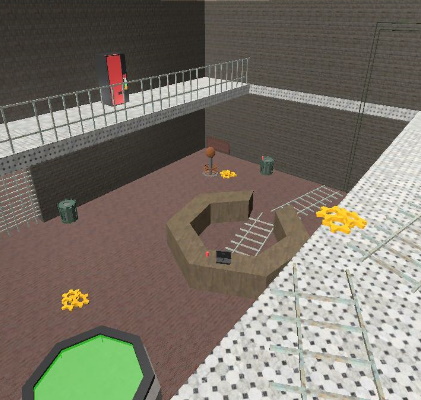
Development:
- Role: Level Designer
- Engine: Unity
- Team Size: 4
- Duration: 3 Months
This project was completed about halfway through University with a team of 3 other students, each of us creating our own levels and mechanics.
Achievements
- Used Unity and C# to design level mechanics for Full Sail University’s Scraps project.
- Trampoline jump
- Object Snapping to open gates
- Integrated my level and mission design with teammates’ levels to create a seamless experience for the player.
- Used Particle system and particle collisions to create electrical effects that damage the player on contact.
Level Design

Post-Mortem

When I was first planning my level, I wanted to come up with a theme that was different from what I anticipated other people choose. The idea I had was that some eccentric out in the wastes took a small shopping mall and modified it into a series of challenges that would need to be passed in order to obtain some treasured object. Throughout these classes I had to strip elements away one by one, but I think I was successful at maintaining that core feel anyway.
Okay, so it started out a little rocky…. But once I was through that initial hump, it was relatively smooth sailing all things considered. I had some fun scripting the trampolines. The first version of them teleported the player into the air, but once I realized that I was setting the player’s location rather than movement, I hopped on Google and started researching different ways of moving objects in Unity. Trying what I think would work, and then running to Google when it doesn’t work quickly became the way I went about everything throughout both courses.

This was probably the most important thing that went right. When it came time to form teams, we got to choose our own. The previous month I’d taken Building Functional Groups and found a handful of other motivated students that I worked particularly well with.
(Note: We continued working together on appropriate projects through the end of University!)
What Went Wrong:
When I was originally planning out this level, I wanted a distinct look and feel that was, unfortunately, just not something I was going to be able to do. I wanted announcements over a loudspeaker (which I only chose not to do because I had to record narration for my level and I didn’t want it to interfere), bright neon signs and flickering lights, and decorations that were something between an Alice in Wonderland and a rave. I’m talking splashes of glow in the dark paint, cryptic riddles, and the object that would be retrieved at the end was going to be a little white rabbit doll. However, all of that was almost completely unattainable without loads of additional research, so I shifted gears and focused on using the assets provided. What I ended up with was much less visually interesting than I’d really hoped for, but was serviceable I suppose.
Originally I’d planned on taking advantage of fall damage in the game for my trampolines. I should’ve realized that there wasn’t any fall damage in Scraps before getting to Level Design, but it never even crossed my mind. Fortunately, it didn’t hurt the mechanic at all.
But then my other mechanic had to be replaced too. I’d wanted to have tesla coils that generated a strong field of electricity almost like a force field. But I was having a lot of trouble getting it to behave the way I wanted it to. I ended up with an awesome hazard but spent far too long getting it to only partially work. So I switched those out for simple gates operated by object snapping. It was solid, but not nearly as cool as the effect I’d hoped for.
This was a recurring problem throughout the team-based parts of the assignment, both myself and the rest of my team just weren’t that confident with Perforce and the updates we were making to our levels sometimes wasn’t being received by our teammates.
The only thing that let my team and I work through these problems and remain productive was how closely we were working together. Nearly every evening we were hopping into voice chat on Discord to talk about any issues we were running into and doublechecking each other’s work to make sure it worked properly on each other’s machines. Each and every time we ran into a problem we weren’t able to solve on our own within a reasonable time, or didn’t know how to do something, we checked in with each other to see if we could solve it as a team. Because of these check-ins and our teamwork, we were able to find and solve version control problems quickly.
Conclusion
It was a journey filled with ups and downs, challenges and solutions. I guess the one constant through everything was that persistence and taking a step back to reevaluate is key. I think the best thing that happened for me was us getting to pick our own teams. The final class for this project was been one of the smoothest and easiest classes I’ve had in months, and I credit my team with that.
 Nicholas Fife